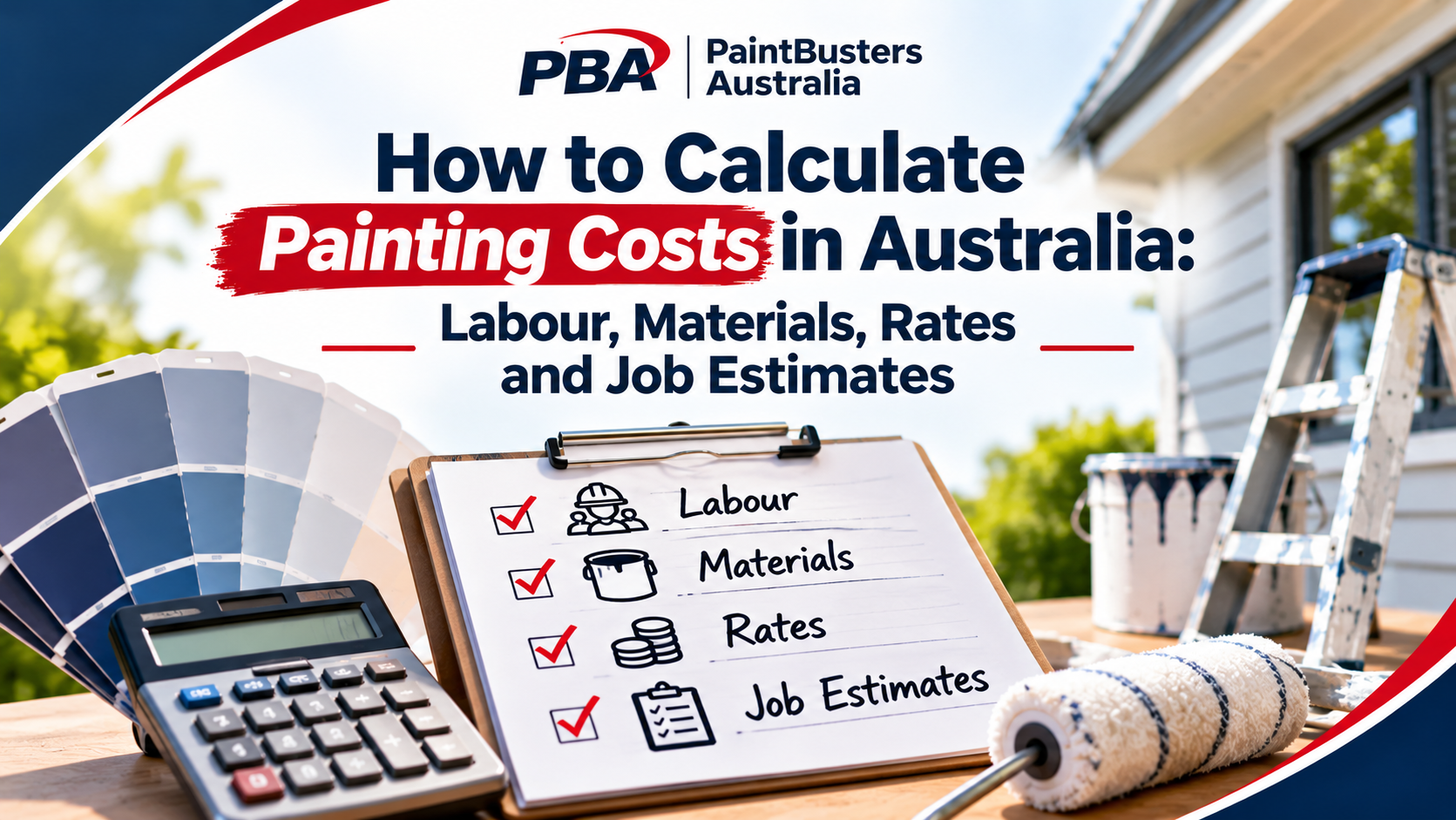
How to Calculate Painting Costs in Australia: Labour, Materials, Rates and Job Estimates
Most painters have underquoted a job at least once and it’s rarely one big mistake. It’s a missed prep day, guessed paint quantities or a markup that wasn’t really a margin. By the time you notice, the paint’s on the walls and the price is locked in.
Accurate painting cost calculation protects a contractor’s profit, lets builders compare quotes like for like, and helps property owners see why two prices for the same house can differ. Here’s the method, using one job from start to finish. The figures are illustrative, so swap in your own.
How to Calculate Painting Costs Step by Step
It all comes down to one formula:
Selling price = (labour + materials + equipment and access + overheads) ÷ (1 − target margin), then add GST.
Work in this order:
- Measure every surface. Wall area is room perimeter × ceiling height, minus openings. Ceiling area is length × width. Trims go in lineal metres.
- Work out labour from your own production rates.
- Work out paint and materials from spread rates and coats.
- Add preparation, equipment and access.
- Add overheads.
- Set the price for the margin you need.
Wall area isn’t floor area. A 4 m × 3.5 m bedroom has 14 m² of floor but about 36 m² of wall before openings. Quote off the floor and you’ll come in well short.
Our example is a three-bedroom interior repaint with 300 m² of wall and ceiling area on sound, previously painted surfaces. The same layout works as a simple painting estimate template for any job.
How to Calculate Painting Labour Costs
Hours = area ÷ production rate. Labour cost = hours × hourly cost.
Hourly cost means wages plus super and on-costs, not just the payslip figure. Take production rates from your own timesheets. For this example, assume 6 m² an hour for two coats, including cutting in and trims.
- 300 m² ÷ 6 = 50 hours
- Preparation (filling, sanding, masking): 10 hours
- 60 hours × $55 = $3,300
Ceiling height, access, occupied rooms and colour changes all move your rate. Painting labour rates in Australia vary from crew to crew, so build yours from your own costs. If you add overheads and profit afterwards, as we do here, don’t load them into the hourly rate too.
How to Calculate Paint Quantity and Material Costs
Litres = area × coats ÷ spread rate.
The spread rate is on the tin or data sheet. Interior wall paints are often somewhere around 12 to 16 m² a litre, but rough or porous surfaces use more.
At 16 m² a litre, two coats over 300 m² need 37.5 litres. Add about 10 per cent for wastage and that’s roughly 41 litres. At an assumed $12 a litre, that’s $495.
Don’t forget primer or undercoat on bare, stained or heavily colour-changed surfaces. Filler, caulk, sandpaper, tape and roller covers add up too. We’ve allowed $200 for these, so materials come to $695.
For a rough budget before you measure anything, try the free paint budget calculator. It gives an indicative range only, so contractors still need a proper take-off.
Painting Cost Per Square Metre in Australia
A rate per square metre is just price ÷ area. No single rate applies everywhere. Region, surface condition, access, finish and scope all move it, and a rate means little unless you know what area it covers. A rate against wall area and a rate against walls, ceilings and trims are different numbers for the same job.
Our example works out at $5,593 (calculated below) over 300 m², or about $18.64 per m². Change the scope, prep or access and that number changes with it. Commercial rates can look lower per square metre because the areas are large, but after-hours work and access equipment pull the other way.
So how much does it cost to paint a house? It depends on scope. Property owners can compare real prices through Get a Painting Quote in Minutes, which sends your job to up to three PBA Member Contractors.
Interior vs Exterior Painting Costs
The formulas stay the same, but the inputs change.
Interior painting cost per square metre is driven by wall area, ceiling height and how much trim there is. Two rooms with the same wall area can cost very differently if one has four doors to cut around.
Exterior painting cost per square metre is driven by the condition of the old coating and by access. A flaking weatherboard house with a second storey needs scraping, sanding, caulking and scaffolding before a brush touches it. Price access as its own line and allow for weather. A lost day is a real cost.
Commercial Painting Cost Estimates
Start with the plans and specification. They set the products, coats, sheens and sign-off requirements, and they decide what you’re actually pricing.
Then measure each surface type separately, because walls, ceilings, door frames and steel all run at different speeds. Group quantities by level or finish so every number traces back to the plans. That’s your take-off.
Finally, turn it into a Bill of Quantities (BOQ): each item with a description, unit, quantity, rate and total, plus clear inclusions and exclusions such as after-hours work, access equipment and how long the price stays valid.
The take-off is the slow part. PaintBusters also has a page on quantity surveying for painting projects.
Additional Costs and Profit Margins
Price extras as their own lines: scaffolding or platform hire, travel, waste disposal and protection. Overheads come next. If yours are $90,000 a year against $750,000 of direct job costs, your overhead rate is 12%.
Then watch markup versus margin. Markup is profit as a percentage of cost. Margin is profit as a percentage of the selling price. Here’s the painting project cost breakdown for our example:
| Line | Amount |
|---|---|
| Labour | $3,300.00 |
| Materials | $695.00 |
| Overheads (12% of direct cost) | $479.40 |
| Total cost | $4,474.40 |
A 20% markup gives $4,474.40 × 1.20 = $5,369.28, which is only a 16.7% margin. A 20% margin gives $4,474.40 ÷ 0.80 = $5,593.00, the figure used above. That’s about $224 lost on one modest job.
What margin should a contractor aim for? There’s no single answer. It depends on your overheads, workload and risk. For more on turning costs into a price, see PaintBusters’ guide to how to price painting jobs in Australia.
Common Painting Estimating Mistakes
- Measuring floor area instead of wall area.
- Using production rates from your best day.
- Leaving out preparation time.
- Trusting the tin’s spread rate on rough surfaces.
- Forgetting wastage, set-up and travel.
- Treating markup as margin, or forgetting overheads.
- Writing vague inclusions and exclusions.
Most come down to not having a repeatable system. PaintBusters’ business estimating course is there for people who want to improve their estimating knowledge.
When to Outsource Painting Estimating
Outsourcing can help if quoting is eating your evenings, several estimates are due in the same week, a tender needs a detailed take-off, or you’re still learning and want something to check your numbers against.
PaintBusters’ professional painting estimating services provide detailed BOQs and painting take-offs with formulas, so you can add your own rates. They suit painting contractors, builders and property owners, and cover residential and commercial projects.
- Estimating services start from $150 + GST.
- A standard single-house internal and external estimate is $240 + GST.
- Larger or more complex projects are individually priced.
The fixed fee is confirmed before you commit. Payment is required upfront once you accept the fee and terms, and estimating begins after payment and all required information are received. The estimating fee is separate from the price of the painting work itself.
Final Thoughts
Measure the right surfaces, turn quantities into hours and litres, recover your overheads and price for a margin, not a guess. If you’d rather spend your time on site than in front of a plan set, have a look at PaintBusters’ estimating services.
Frequently Asked Questions
How do you calculate painting costs in Australia?
Add labour, materials, preparation, equipment and overheads, then divide by (1 − your target margin). Add GST.
How do you calculate how much paint is needed?
Area ÷ spread rate × number of coats, plus roughly 10 per cent for wastage.
What’s the difference between markup and margin?
Markup is profit on cost, margin is profit on the selling price. A 20% markup is only a 16.7% margin.
How much does a painting estimating service cost?
PaintBusters’ services start from $150 + GST, and a standard single-house estimate is $240 + GST. Larger projects are individually priced.
Is the estimating fee the same as the painting job price?
No. The fee covers preparing the estimate and is separate from the cost of the painting work.